





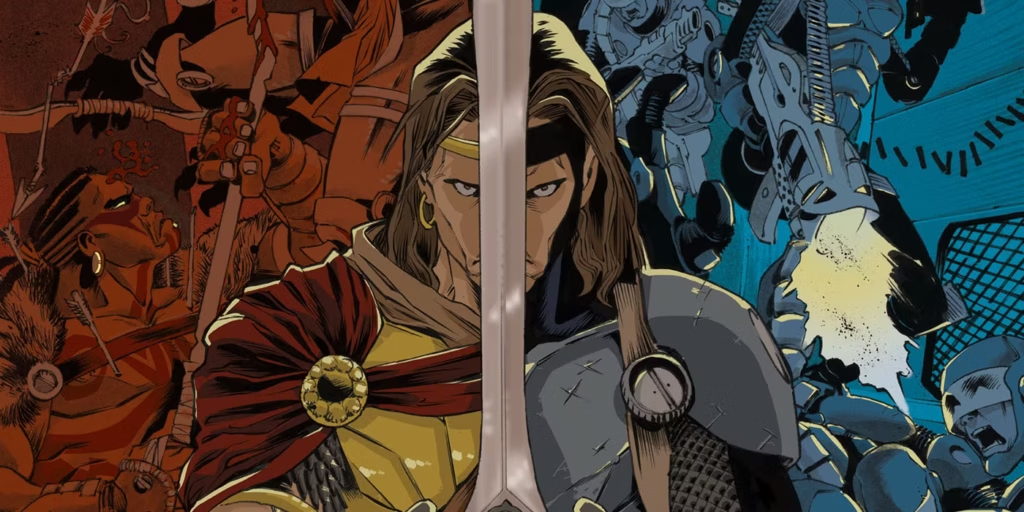
The Relationship Between Conan the Barbarian and Kull of Atlantis
You know Conan. The barbarian, the Cimmerian, the Arnold movie, the franchise.
Even if you’ve never read a single Robert E. Howard story, you know the silhouette: the sword, the throne, the savage who conquered a civilized world.
What almost no one knows is the character who came before him. Not before him as in “inspired by” or “in the same tradition.” Before him as in: Conan’s first story was built from the literal manuscript of a rejected tale of a different character known as Kull of Atlantis, and the most iconic elements of the franchise you already love were never Conan’s to begin with.
Nearly everything the popular imagination believes about the relationship between these two characters is backwards. This is the correction.
Which Came First: Kull or Conan?
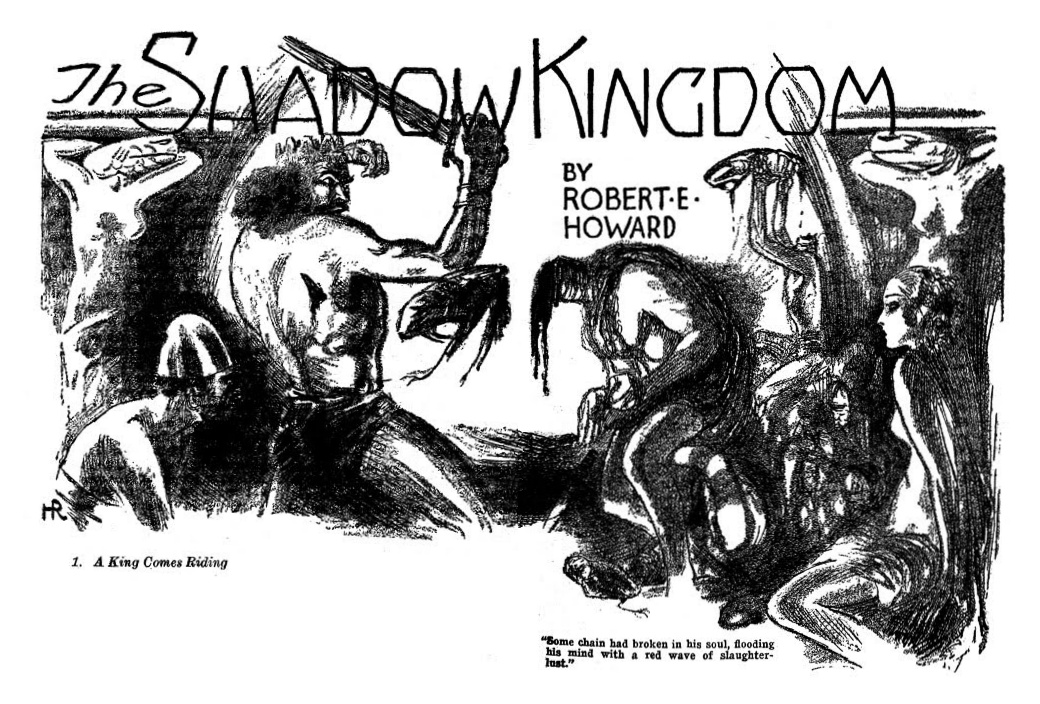
For those people who’ve heard of Kull of Atlantis, they sometimes think he’s a lesser Conan, a knockoff barbarian cooked up to ride the Cimmerian’s coattails. The publication record says the opposite. Kull’s first story, “The Shadow Kingdom,” appeared in Weird Tales in August 1929. Conan didn’t show up in that same magazine until December 1932, more than three years later. Same author, same publisher, same genre, with Kull arriving first.
The priority isn’t just a bibliographic footnote. Inside Robert E. Howard’s fictional universe, Kull’s era predates Conan’s by tens of thousands of years. Howard set Kull in the Thurian Age, a pre-cataclysmic epoch that his own fictional historians place roughly eight millennia before the Hyborian Age where Conan lives. Modern scholars push that gap far wider, to approximately 100,000 years. Either way, Kull’s world is the ancient foundation buried underneath Conan’s.
So why does almost everyone get the relationship backwards? Because they saw the movie.
In 1997, Universal Pictures released Kull the Conqueror with Kevin Sorbo in the title role. It earned $6.1 million against a $30 million budget, landed a 25% on Rotten Tomatoes, and left audiences with a single lasting impression: Kull was a cheap imitation of the 1982 Conan the Barbarian they actually loved. The film failed commercially, yes, but it also buried a literary legacy. Viewers who had never encountered Howard’s original 1930s stories had no reason to question what the movie was telling them, which was that Kull was second-rate.
He wasn’t. He was first.
How Did the Character of Kull Influence the Sword and Sorcery Genre?
Howard wrote twelve Kull stories. Only three sold during his lifetime, all to Weird Tales between 1929 and 1930. The rest accumulated in his rejection files, casualties of a pulp market that didn’t know what to do with a barbarian king who questioned reality as often as he fought.
The first of those three published stories changed the landscape of fantasy literature. “The Shadow Kingdom” is recognized by scholars including Patrice Louinet, L. Sprague de Camp, and Isaac Asimov as the first true sword and sorcery story ever written. Asimov stated that the genre “owes its existence to the imagination of Robert Howard.” The claim rests on what the story actually accomplished: it fused Lovecraftian supernatural horror with pulp action-adventure pacing and set both inside a wholly invented prehistoric world.
Before August 1929, those ingredients existed separately. After “The Shadow Kingdom,” they were a genre.
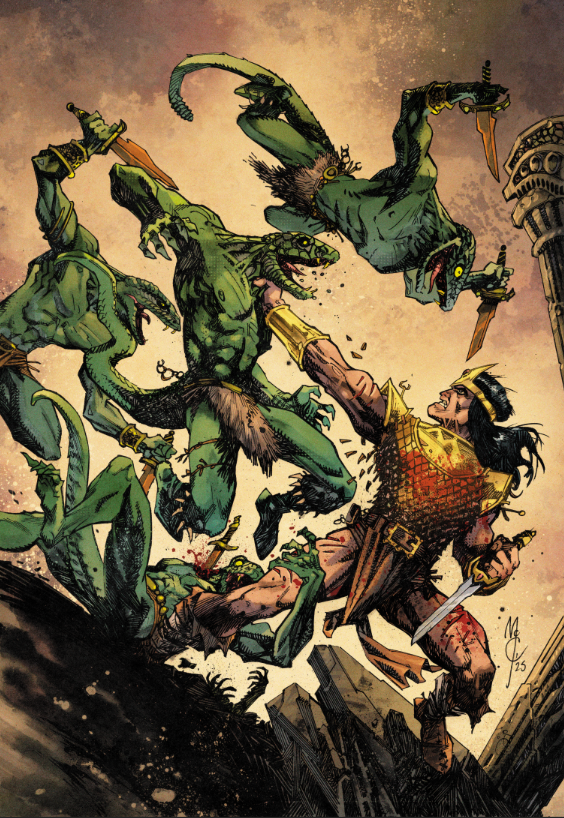
That story also introduced the Serpent Men: ancient shapeshifters who had ruled Valusia from the shadows by impersonating its leaders. They gave Kull an enemy that couldn’t be beaten with a blade, only uncovered through paranoia and vigilance. They also, through a chain of cultural transmission documented by political scientist Michael Barkun at Syracuse University, became the direct origin point for modern reptilian conspiracy theories, traveling from Howard’s 1929 fiction through occultist Maurice Doreal to David Icke’s Children of the Matrix in 2001. A pulp adventure monster became a global phenomenon, and its birthplace was a Kull story.
But the most consequential moment in Kull’s history was actually a rejection of one of his stories. Around 1929, Howard wrote “By This Axe I Rule!”, a story about Kull facing an assassination conspiracy interwoven with a forbidden love subplot. It was pure political adventure with no sorcery, no monsters, no supernatural threat. Argosy rejected it. Adventure rejected it. It sat unsold for three years.
How Did the Story “By This Axe I Rule?” Become a Conan Story?
In March 1932, creatively blocked and unable, as he wrote to Clark Ashton Smith, to “work up anything sellable,” Howard pulled the out manuscript for “By This Axe I Rule!” and rebuilt it. He kept the assassination plot and lifted passages wholesale to tell the first of his stories for his new character: Conan the Barbarian.
Kull’s last stand with his back against the wall, “legs braced far apart, head thrust forward,” became Conan’s last stand in nearly identical language, down to the hand gripping the weapon overhead. He kept the conspirators and renamed them for a new setting. Then he cut everything that had made the story unsellable. The romantic subplot disappeared. Kull’s anguished declaration of “I am king!” was deleted entirely, because the new protagonist would never require that kind of self-justification.
In their place, Howard added a Stygian sorcerer named Thoth-Amon who summons a demon, a dead sage who marks the king’s sword with a glowing phoenix, and, critically, the weapon itself changed from an axe to a sword, a shift from a tool of primitive destruction to a symbol of civilized authority. The result was “The Phoenix on the Sword,” the first Conan story, sold immediately to Weird Tales.
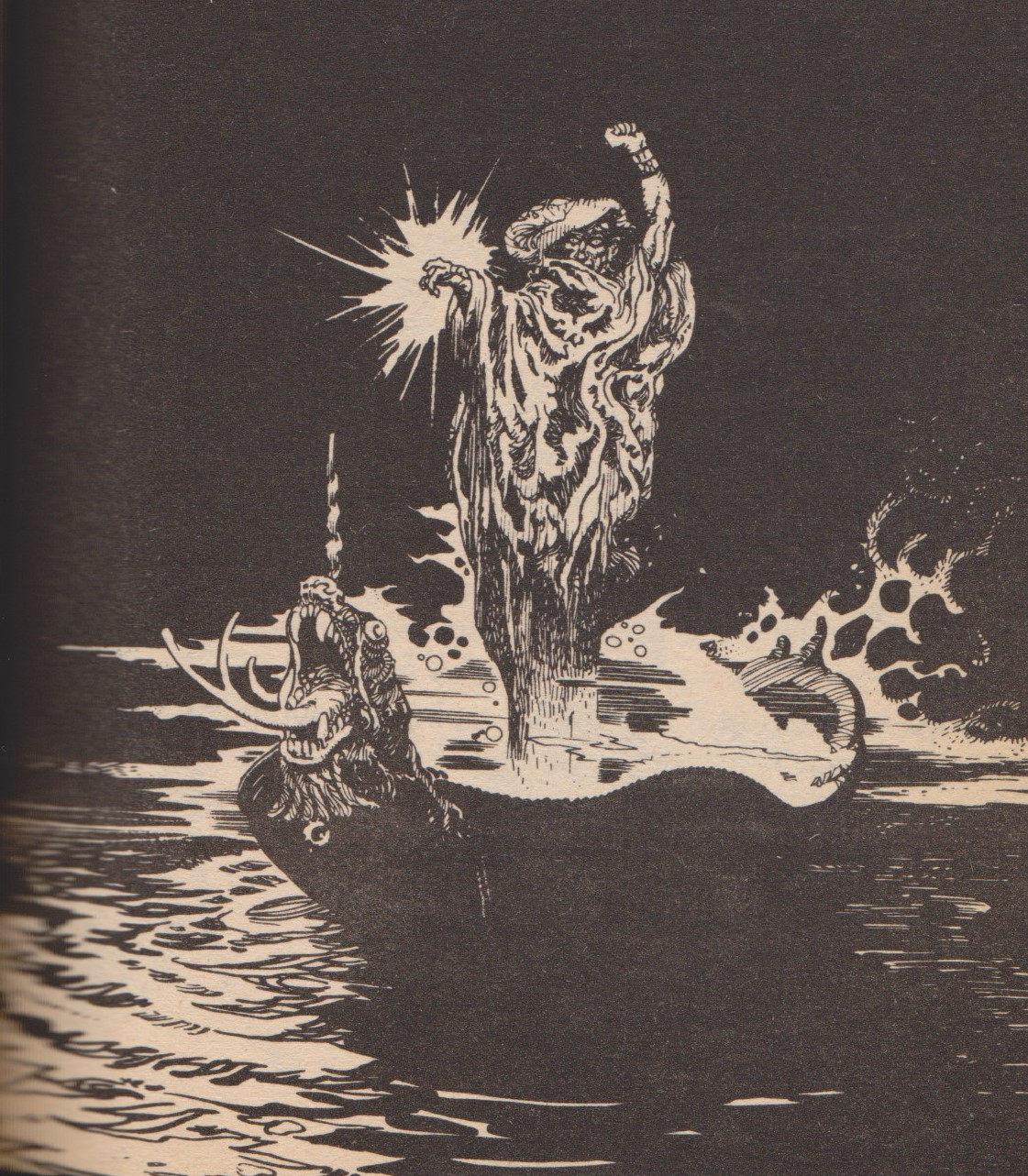
What Howard cut from that manuscript reveals the two characters more clearly than what he kept. In “The Mirrors of Tuzun Thune,” Kull gazes into a magic mirror and whispers, “Am I Kull? Do I stand here or is that Kull yonder in very truth and am I but a shadow, a figment of thought?” Conan, built from those bones, is introduced as a man of “gigantic melancholies and gigantic mirth” – someone who feels enormously but never doubts. Howard’s text explicitly states that Kull “had never been a lover”; Conan collected romances across every story he appeared in. Howard stripped the solitude and the uncertainty out of his Atlantean king, replaced them with appetite, and the pulp market that had starved Kull devoured Conan whole.
Did the Character of Kull of Atlantis Influence the Movie Conan the Barbarian?
The 1982 Conan the Barbarian is the definitive screen adaptation of Robert E. Howard’s work. It is also, in its most essential elements, a Kull movie.
The film’s most iconic villain, Thulsa Doom, is not a Conan character. Howard never used him in a single Conan story. Thulsa Doom belongs to the Kull mythos, appearing in stories like “Delcardes’ Cat.” The serpent cult that drives the film’s plot traces directly to the Serpent Men of Valusia from “The Shadow Kingdom”, which is from Kull’s story, not Conan’s. And the origin that gives the film its emotional spine – a boy enslaved, broken on a wheel, forged into a gladiator who fights his way to freedom – has no basis in Howard’s Conan literature whatsoever.
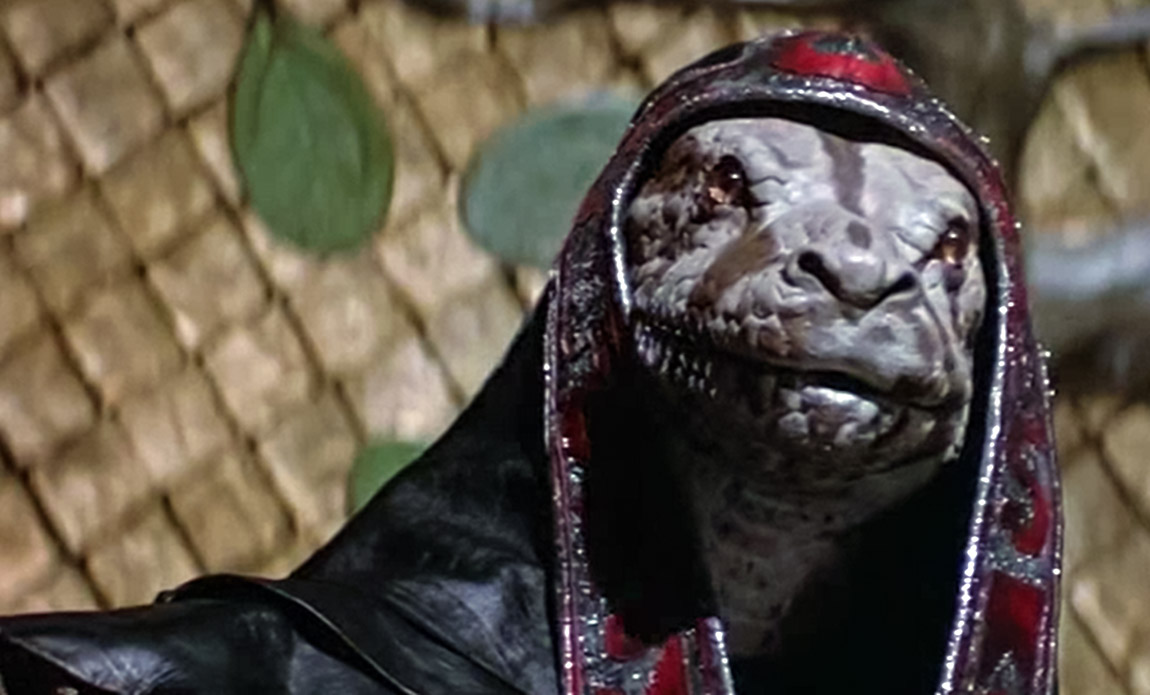
Howard’s Conan was never a slave. He was never a pit fighter. He left Cimmeria as a free wanderer because he wanted to see what was on the other side of the hills. The enslaved-child-to-warrior-king arc belongs to Kull, whose origin in “Exile of Atlantis” follows a feral youth captured, enslaved, and eventually hardened by brutality into the man who would seize Valusia’s throne.
The reason why this backstory was lifted was because the film’s director, John Milius, had a practical problem: Conan’s literary adventures are episodic. He wanders, he fights, he moves on. That’s compelling across a dozen short stories but structurally useless for a three-act Hollywood epic that needs a dramatic trajectory from suffering to triumph. Kull’s backstory provided exactly that arc. Milius built one of the great fantasy films by grafting Kull’s origin, Kull’s villain, and Kull’s mythology onto a character named Conan. And the audience, having never read the source material for either, didn’t notice.
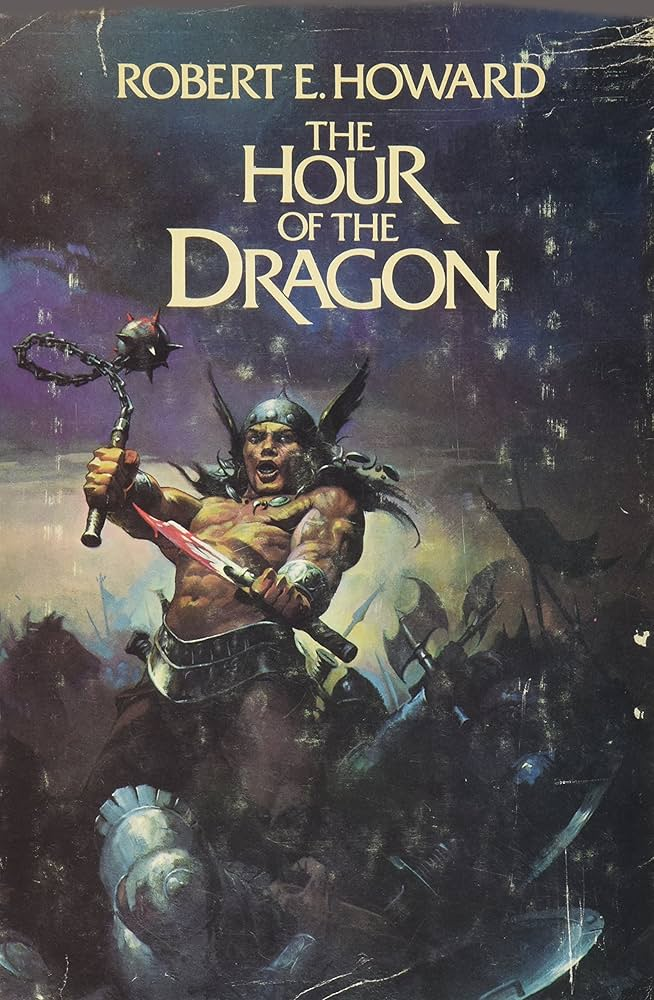
This matters for what happened fifteen years later. Through the late 1980s and 1990s, producer Dino De Laurentiis attempted to revive the franchise. Various iterations came and went, including a script by Karl Wagner and later interest from the Wachowskis and John Milius in a project called King Conan: Crown of Iron. The version that finally reached pre-production was a complete, R-rated script by screenwriter Charles Edward Pogue, adapted from Howard’s only full-length Conan novel, The Hour of the Dragon. It was designed as a mature, darkly violent epic.
Then Arnold Schwarzenegger declined to return.
Without their star, Universal pivoted. They signed Kevin Sorbo and retooled Pogue’s Conan III script into a film about Howard’s other barbarian. The result was 1997’s Kull the Conqueror, a movie adapted from a Conan novel, featuring a Conan-specific character (the vampiric witch Akivasha) as its primary antagonist, wearing the structural bones of a story that was never designed for the character whose name was on the poster. Where Howard had transmuted Kull into Conan by stripping away philosophy and adding supernatural urgency, Universal attempted the reverse.
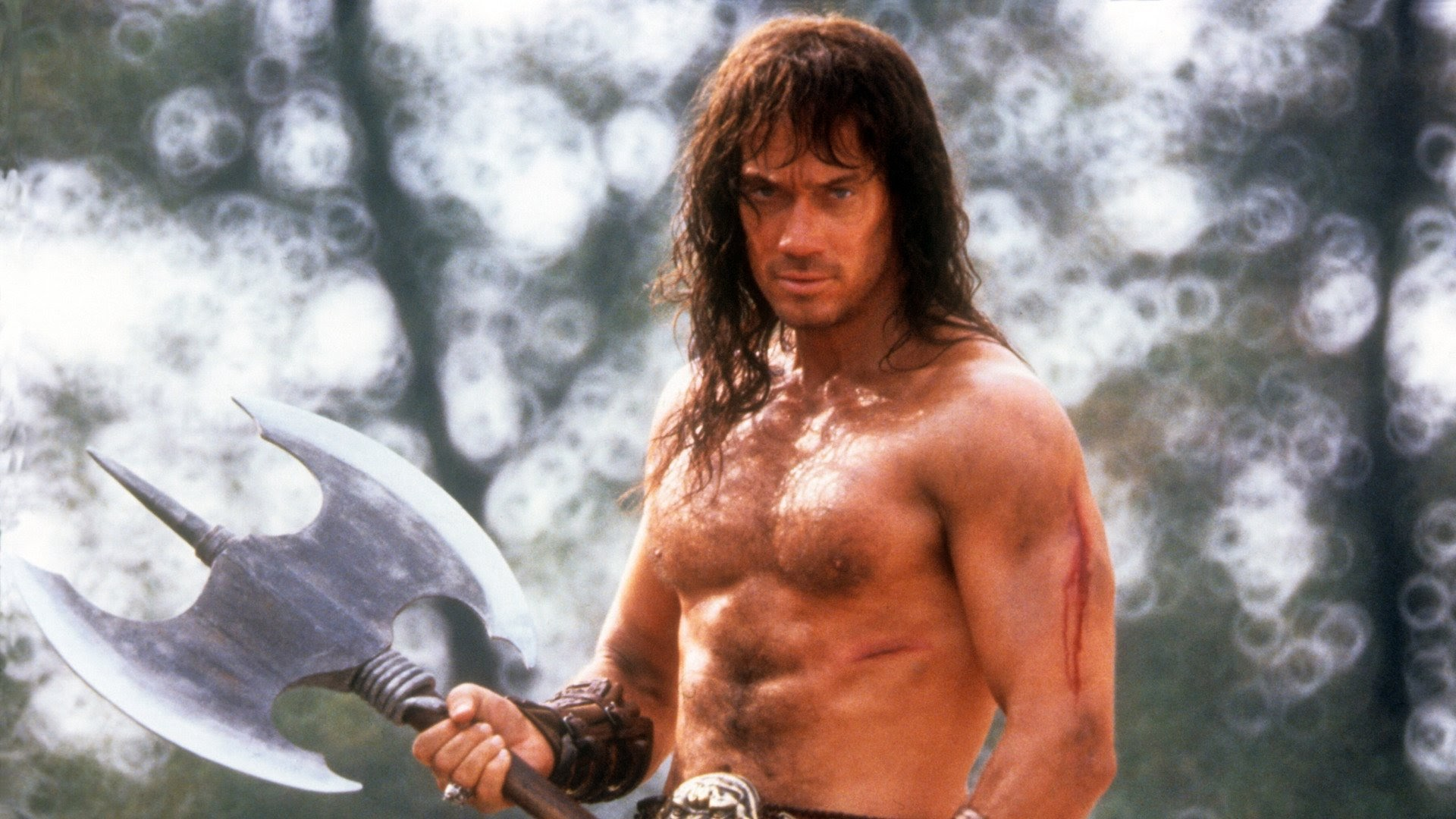
The damage went deeper than a clumsy script swap. In a detailed public account of the production, Pogue’s original script was, in his words, “ripped asunder by another writer and dumbed down to the comprehension level of an eight year old.” Complex female characters were reduced to what Pogue called a “damsel in distress and evil witch.” What had been conceived as “Conan by way of Spartacus” became “Conan by way of Red Sonja.”
The symmetry with Howard’s 1932 alchemy is almost too neat. Howard took a failed Kull story and made it work by understanding exactly what the market needed: supernatural horror, a protagonist who acted rather than brooded, and forward momentum. Universal took a Conan story and tried to make it work by changing the name on the title page. They changed the story to serve the deal. Howard’s version launched a genre. Universal’s version earned $6.1 million and a 25% on Rotten Tomatoes, and for the next three decades, the name “Kull” meant Kevin Sorbo in a leather vest to anyone who hadn’t read a pulp magazine from 1929.
What is the Thurian Age and What is its Connection to the Hyborian Age?
None of this world-crossing borrowing between film adaptations would have been possible if Howard hadn’t already built the connection himself.
In the 1930s, he wrote “The Hyborian Age,” an 8,000-word pseudo-historical essay mapping the rise and fall of civilizations across his fictional timeline. It was never intended for publication. Instead, Howard used it as an internal bible to keep his mythology consistent. The essay draws a direct geological and cultural line from Kull’s Thurian Age, through a world-shattering cataclysm, to every nation on Conan’s map.
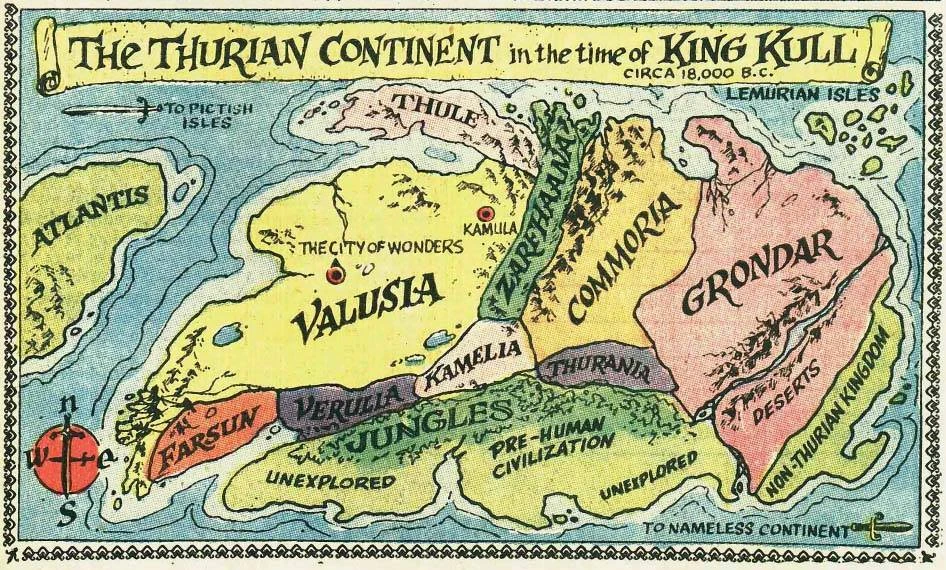
The connections are specific. In Kull’s time, Atlantis was a savage western island continent and was Kull’s homeland. During the Great Cataclysm, it sank. The surviving Atlantean refugees fled to the main continent, where they devolved over millennia into what Howard called “bestial half-men,” then slowly re-evolved into a grim, brooding mountain people called the Cimmerians. Conan’s people. Conan is a blood descendant of Kull’s Atlanteans, separated by a catastrophe and tens of thousands of years of regression and recovery.
The Picts survived too, though not without immense strife, as they lost their culture and devolved from the Thurian Age straight through to the Hyborian. Meanwhile Kull’s glittering kingdom of Valusia was torn apart completely, submerged under new oceans, and erased from the map. By Conan’s time, it persists only as a dim legend of a civilization so old that no one believes it was real. Even the Serpent Men endured in reduced form, operating shadowy cults of Set from whatever pockets of the world would still hide them.
Howard occasionally let this buried history surface inside Conan’s own adventures. In “The Tower of the Elephant,” one of the most celebrated Conan stories, a young Conan breaks into a sorcerer’s tower in Zamora and encounters Yag-kosha: a blind, captive, elephant-headed being who delivers a haunting eyewitness account of the pre-Cataclysmic age, naming the lost kingdoms of Valusia and Commoria as places he personally remembers. The scene is Conan at his most human and it only works because Kull’s world exists underneath it. In “Kings of the Night,” Howard went further, pulling Kull bodily forward through time so that the Atlantean king could fight alongside the Pictish king Bran Mak Morn against Roman legions. It is easy to think that Kull’s world is just backstory, but this betrays its significance, as it truly serves as the subterranean layer which gives Conan’s world any weight at all.
Get Excited for New Kull Comics in 2027!
For decades, reading Kull meant settling for less than what you probably wanted.
Posthumous collaborators like Lin Carter rewrote Howard’s prose, smoothed his rough edges, added their own titles, and published the results as though they were authentic. Readers who sought out Kull in the 1960s and ’70s paperbacks were getting a cover band, not the original recording.
That changed in 2006 when Del Rey published Kull: Exile of Atlantis: a complete, unaltered collection of every Kull story, fragment, and poem Howard wrote, edited with scholarly precision by Patrice Louinet and illustrated by Justin Sweet. It remains the definitive edition, and it reads nothing like what the pastiche versions promised. These stories are slower than Conan, more melancholic, more willing to sit with a king who isn’t sure his crown means anything. They reward the kind of reader who loves The First Law or the ambient dread of Elden Ring’s lore, for people who want their fantasy to think as hard as it fights.
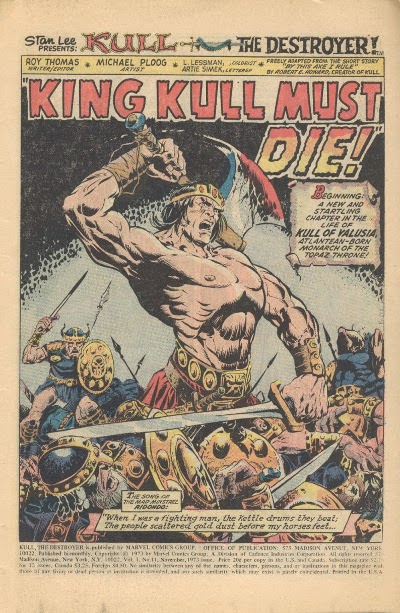
Kull has also never fully disappeared from comics. Marvel kept him alive through the 1970s in titles like Kull the Conqueror and Kull the Destroyer, with creators including Roy Thomas, Marie Severin, and Wally Wood expanding Howard’s mythology in ink. Dark Horse carried the torch through the 2000s and 2010s with Chronicles of Kull reprints and new adaptations. The character has always had champions willing to keep the flame lit between the long gaps of mainstream attention.
Those gaps are closing. Heroic Signatures has spent the last several years executing a coordinated revitalization of the brand. At their 2024 and 2025 San Diego Comic-Con panels, they made clear that the expansion isn’t stopping with the Cimmerian. Kull the Conqueror is returning to comics with his own dedicated series in 2027, published in partnership with Titan, as a pillar title of the Howard universe.
If you want to be ready when the new series arrives, start here: “The Shadow Kingdom,” “The Mirrors of Tuzun Thune,” “By This Axe I Rule!,” “Exile of Atlantis,” and “Kings of the Night.” Five stories. The complete foundation. Everything the genre was built from, written by the man who built it, before anyone else knew what to call it. Then, pick up Kull: Exile of Atlantis from Del Rey and read them in that order.
By the time Kull returns to comics in 2027, you’ll know exactly who’s sitting on that throne and why he was there first.